
Running a Klickitat County Sex Offender Check
Start with the Washington Association of Sheriffs and Police Chiefs registry links for Washington public-notification records. County sheriffs manage registration duties, while Washington law controls what may be disclosed. The Klickitat County Sheriff's Office monitors registrants who reside in Klickitat County and those who work here while living elsewhere. A name, address, city, ZIP code, or map view may narrow a search, depending on the linked registry interface.
The National Sex Offender Public Website, or NSOPW, adds participating jurisdictions outside Washington. It is useful near the Columbia Gorge, where a location search may cross a state line. Neither channel is a complete criminal-history search. Public visibility depends on Washington's notification rules, data supplied by each jurisdiction, and the person's status. Confirm a match with more than a shared name before relying on it.
Before searching, decide whether the question concerns a known person or a place. A name search is more useful when spelling and aliases are known. A geographic search helps with neighborhood awareness, but its scope depends on address data each jurisdiction may lawfully show. Search both ways when the first route gives an unclear answer. The Klickitat County Sheriff's Office can explain the local process, but it cannot turn restricted Level I data into a broad public listing.
The NSOPW national interface shows how the public search begins and why the conditions of use matter.
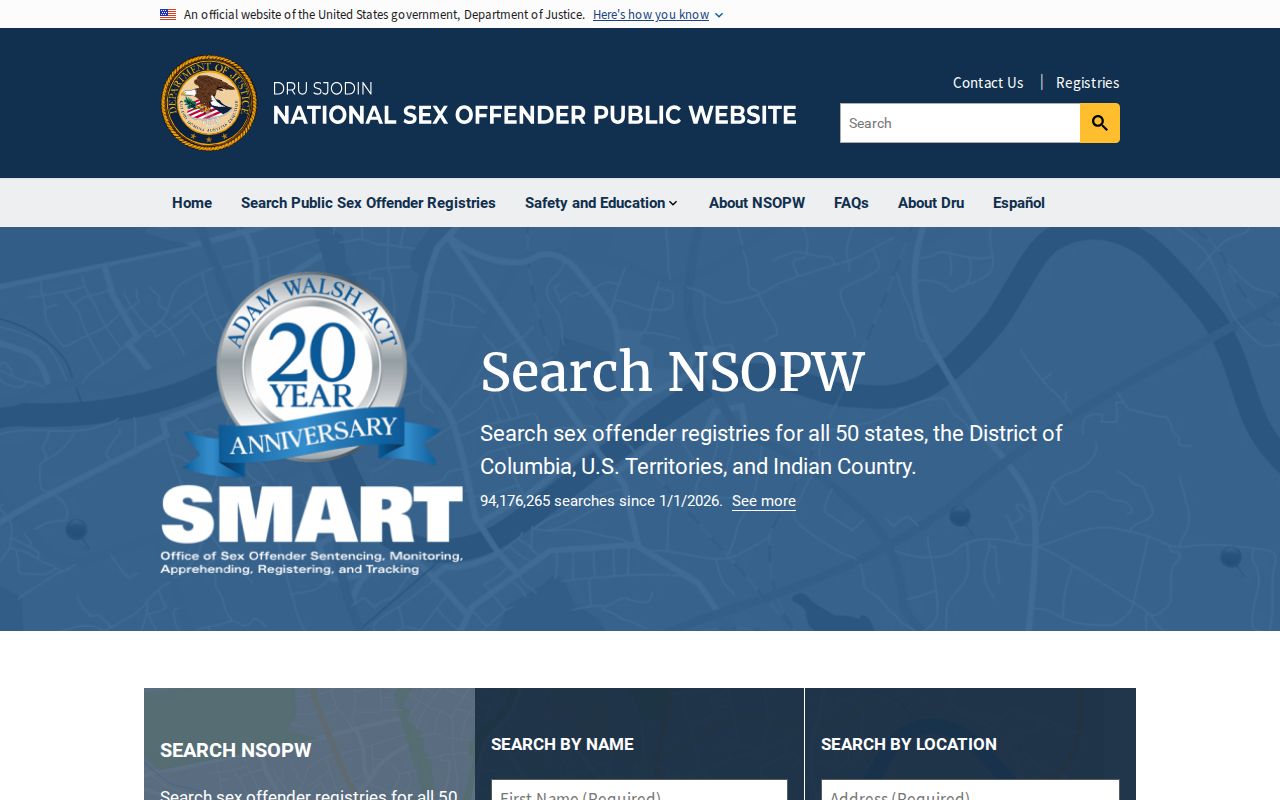
That search is the cross-state layer, while the Klickitat County sheriff remains the local registration contact.
Klickitat County Registry Counter
Registration questions go to the Klickitat County Sheriff's Office at 205 South Columbus Avenue, Room 108, Goldendale, WA 98620. Call 509-773-4455 before visiting to confirm the reporting process or arrange an appointment. The office is the practical contact for a person who must register, a resident with a lawful registry question, or someone who needs to report a suspected compliance issue.
Klickitat County Sheriff's Office
205 S Columbus Ave, Room 108
Goldendale, WA 98620
509-773-4455
Call first for registration and reporting procedures.
Under RCW 9A.44.130, qualifying sex and kidnapping offenders register with the sheriff. The law addresses release, sentencing, moving, temporary stays, and people without a fixed residence. A person without a fixed address generally reports weekly on the sheriff's assigned day and accounts for the places stayed.
Registration generally occurs in person within three business days after release, sentencing, or establishing the Washington connection that triggers the duty. A visitor who plans to remain ten days or more also faces a temporary-location rule. These deadlines describe the registrant's duty, not the time a public web page must update. The sheriff transmits specified registration information to Washington State Patrol under RCW 43.43.540, generally within five working days.
Klickitat County also tracks a person who works in the county while residing elsewhere. That fact matters along a county and state border. A residence-only search can miss a lawful work connection if the participating jurisdiction does not display work detail. Review the available work and school fields, then ask the sheriff a focused process question if a public notice leaves the jurisdiction unclear.
The registration data collected by law includes more than a public map may reveal. It can include names and aliases, planned or current location, birth information, employment, conviction details, Social Security number, photograph, and fingerprints. Sensitive or restricted fields stay within official systems. Public searchers should not assume that every item collected at Room 108 must appear on an open profile.
The Washington registration-duty page provides the governing text used by the Klickitat County registration office.
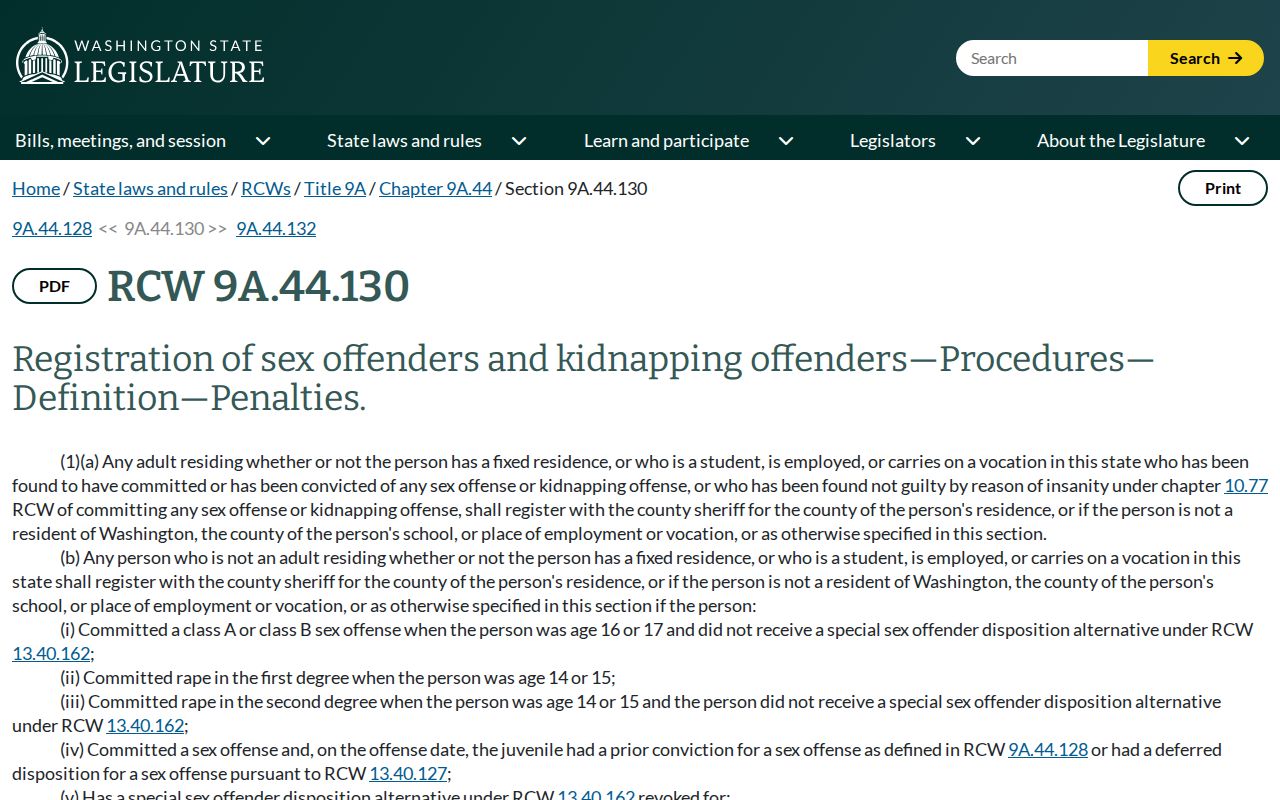
Those duties should be read from the current statute because timing and notice depend on the person's circumstances.
Searching the Washington Sex Offender Public Registry
The official Washington route sends the public through county registry links. NSOPW can search participating jurisdictions at once. Use the Washington route for Klickitat County details, then use NSOPW when a name or address question may extend beyond the county or state. Search results are for awareness, not confrontation.
- Open an official Washington county link or NSOPW. Read and accept the conditions of use, and complete any captcha.
- Search by name or use an available address, city, county, ZIP, radius, map, or list control.
- Compare the result with lawful identifiers. A common name alone is not enough to establish a match.
- Open the public profile and read the offense, address detail, risk level, and compliance fields in context.
A broad result list should be narrowed without guessing. Compare aliases, photograph, physical description, conviction jurisdiction, and registered location only when those fields are available. Birth information may be displayed in a form allowed by the source jurisdiction. If two profiles appear similar, the responsible sheriff or registry agency should resolve the question. Do not use an old screenshot as proof of current address or status.
| Field Label | Type | Required | Notes |
|---|---|---|---|
| Name | Text | Route-dependent | Use first and last name; spelling affects results. |
| Address | Text | For address search | Street, city, state, or ZIP formatting may apply. |
| City, County, or ZIP | Text or selection | No | Use Klickitat County or a local place to narrow results. |
| Radius | Dropdown | No | Options depend on the participating jurisdiction. |
| Map or List | View control | No | Availability varies by source jurisdiction. |
| Accept Conditions | Checkbox or button | Yes | Terms and a captcha may appear before search. |
The radius option is not guaranteed for every county feed. NSOPW combines participating systems, so controls and returned detail can vary. A missing map marker may reflect restricted disclosure, an unsupported location tool, or a jurisdictional difference. It should not be read as a statement that no registration duty exists. When the search is for Klickitat County only, pair the national result with the Washington county-registry route.
Klickitat County Registry Visibility
A broad map is not a list of every registered person in Klickitat County. Level I information is usually subject to narrow disclosure under Washington law, while Level II and Level III classifications permit broader notice. This means a careful public search can return no profile even when registration duties exist.
The WASPC sex-offender information page provides the state and county registry path. It also helps distinguish a public-notification search from a complete court or criminal-history record. For an older charge, disposition, or sentence, the court file answers a different question than a registry profile.
Washington does not use federal SORNA tier names as substitutes for its risk levels. A federal label may refer to an offense category or national framework, while the Klickitat County notice describes assessed public-notification risk. Mixing the systems can produce a false claim about visibility or duration. Read the exact label shown by the Washington source, then use the conviction category and duration statute for the separate time question.
The Washington registry-links source illustrates the county-based public search structure.
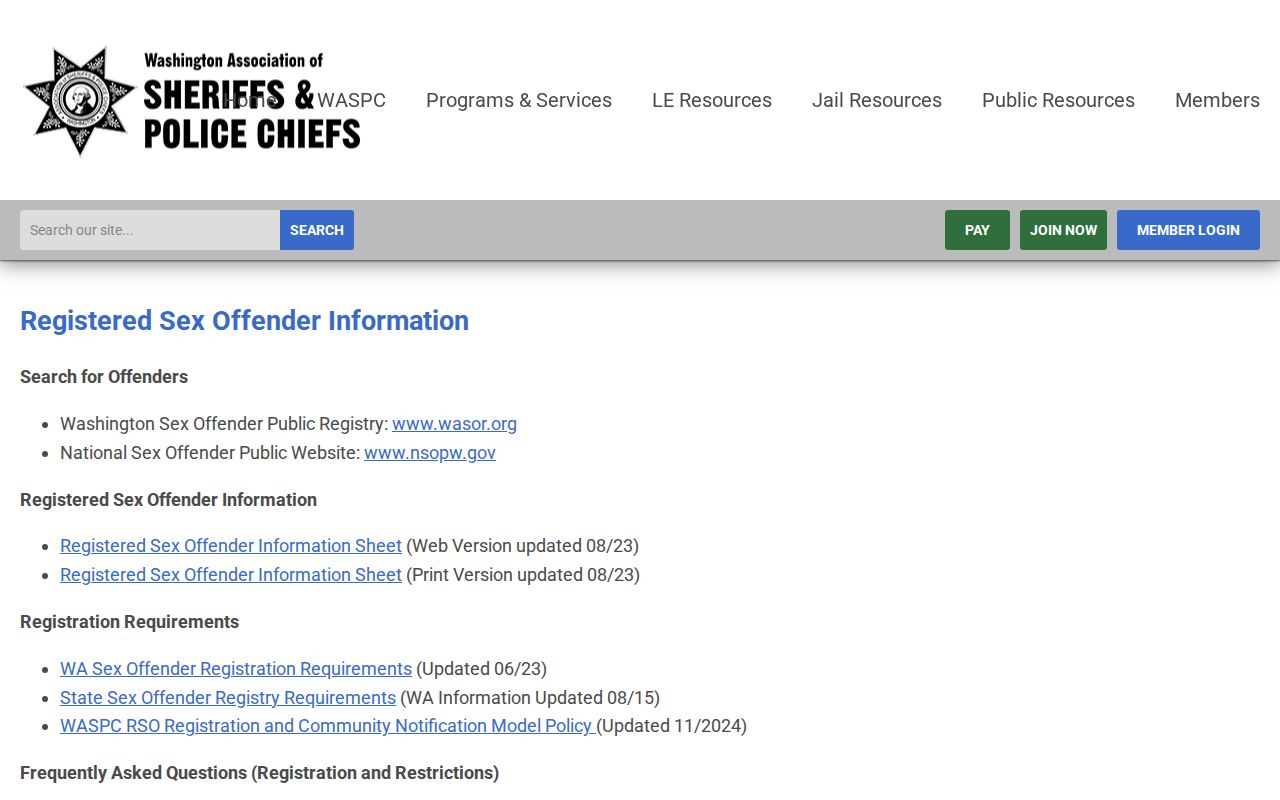
That structure reflects the sheriff-led registration and notification system used across Washington.
What a Registry Profile Shows
A public Klickitat County sex offender profile may combine identity, appearance, location, offense, and compliance details. Fields vary by the participating jurisdiction and the disclosure allowed for that person. Not every profile contains every category, and address detail may differ. Read each label instead of treating the page as a full criminal case file.
Possible identity fields include aliases, photograph, sex, race, height, weight, hair, eyes, and birth information as lawfully published. A participating jurisdiction may also supply registered residence detail, workplace or school information, offense statute and conviction place, vehicle data, and visible scars, marks, or tattoos. Compliance status is an agency field. It does not state whether every condition of supervision has been met, nor does it replace a court's sentence.
| Name and Aliases | Publicly displayed identity names supplied by the jurisdiction. |
|---|---|
| Photo and Description | Photograph and available sex, race, height, weight, hair, eyes, or marks. |
| Registered Location | Residence detail and, where authorized, work or school information. |
| Offense Information | Offense description, statute, conviction date, or conviction jurisdiction. |
| Risk Level | Washington public-notification risk classification, not a duration tier. |
| Registration Status | Compliance or registration status as supplied by the responsible agency. |
| Other Public Fields | Vehicle data or scars, marks, and tattoos where the law permits publication. |
Profile data should be tied back to its source jurisdiction. A photograph can age, an address can change, and an offense label can be shorter than the language in the judgment. Public registry entries were not collected from private individuals for this project. The field inventory reflects official interface categories only. That keeps the focus on how to read a record without republishing personal data.
Klickitat County Registry Address Concerns
Do not visit the address or contact the person. First, recheck the profile date, status, and jurisdiction. A move may be in process, the displayed detail may be limited by law, or the wrong person may have been selected. Save the public profile link and note the fact that appears inconsistent.
Report a suspected Klickitat County compliance issue to the Sheriff's Office through 509-773-4455 or the county's 24-hour non-emergency dispatch line at 509-773-4545. Give the source and observed concern without making a public accusation. Call 911 only for immediate danger. Agency staff can compare the tip with nonpublic registration data and decide whether follow-up is warranted.
A useful report is factual and limited. State the profile or search route used, the date it was viewed, and the specific address or status field that seems inconsistent. Avoid assumptions about guilt, motive, or risk. The sheriff determines whether the matter calls for verification or investigation. If the issue appears to be a spelling, photo, or display error, use the correction or tip route shown on the profile when one is available.
Note: A registry mismatch should be reported through official channels, not corrected through social media or personal contact.
Registration Requirements and Levels in Washington
Washington risk levels describe assessed public-notification risk. Klickitat County's published notice calls Level I low risk, Level II low-to-moderate risk, and Level III high risk. These labels affect how broadly information may be shared. They do not, by themselves, set how long someone must register.
Level I information is generally disclosed only within limits set by law. Level II permits wider community notice, and Level III permits the broadest public notice. The classification is not a prediction that a specific act will occur. It is a law-enforcement risk category used to make notification decisions. The absence of broad Level I publication is therefore a feature of the Washington system, not proof that the local register is incomplete.
| Risk Level | Local Description | Public Treatment |
|---|---|---|
| Level I | Low risk | Disclosure is narrowly limited; broad web notice is uncommon. |
| Level II | Low-to-moderate risk | Broader community and public notice is authorized. |
| Level III | High risk | The broadest public-notification treatment is authorized. |
Klickitat County Registry Risk and Duration
Risk and time are separate parts of a Klickitat County registry record. The risk level controls the scope of public notification. Registration duration comes from the conviction category, prior qualifying history, age in juvenile matters, the statutory start point, and any relief the law permits. Federal SORNA tiers should not be substituted for Washington's Level I, II, and III labels.
RCW 9A.44.140 supplies the Washington duration rules. The baseline categories below summarize the research, but the statute and case record control an individual duty.
| Triggering Category | Baseline Duration |
|---|---|
| Adult Class A qualifying offense or qualifying prior history | Life, subject to statutory relief |
| Adult Class B qualifying offense | 15 consecutive crime-free years after the statutory start point |
| Adult Class C or covered gross misdemeanor without a prior qualifying conviction | 10 consecutive crime-free years after the statutory start point |
| Juvenile age 15 through 17 with a Class A triggering offense | 3 years |
| Other juvenile required to register | 2 years |
A same-county address change generally requires signed written notice in person or by certified mail with return receipt within three business days. Washington also has no universal statewide distance ban that applies to every registrant. A sentence or supervision order may impose person-specific limits.
The crime-free period is counted from the statutory start point, not from a risk-level assignment. Prior qualifying history can also change the baseline category. Relief is not automatic merely because the listed number of years has passed. Anyone checking their own duty should use the judgment, current statute, and legal advice rather than infer an end date from a public profile.
Juvenile categories demonstrate why the duration table cannot be merged with the risk table. The research identifies a three-year baseline for a person who was age 15 through 17 with a Class A triggering offense and two years for another juvenile required to register. Those are duration categories. They do not mean that the person is assigned a matching public risk level or that relief questions can be answered without the case record.
Address rules also depend on the kind of change. A move within Klickitat County has its own written-notice method, while a move across jurisdictions can require notice to more than one sheriff. A person without a fixed residence follows the weekly in-person rule. These mechanics help explain why a profile may display a location description instead of an ordinary street address.
Klickitat County Registry Alerts
WASPC offers email alerts through its iCrimeWatch service for moves within one mile of a chosen address. Level II and Level III arrivals may also lead to community notification, with the method and range chosen by the jurisdiction. Classification review can take weeks or months, so timing may differ from an informal report or an older search result.
An alert is tied to a chosen location and a reported move. It is not a daily criminal-history report or a guarantee that every person subject to registration will appear in the message. Residents should keep the alert radius focused on the place that matters and follow the official link in any notice. Forwarded posts can lose the date, legal warning, and agency context needed to interpret the information safely.
Klickitat County's local notice describes the public treatment of the three risk levels, but the sheriff chooses notification methods within Washington law. A notice may reach the community differently from an email-radius alert. Always check which agency issued it and when. An authentic notice should be read with its restrictions intact. If a copied notice lacks a source or date, return to the official registry link or call the Sheriff's Office before sharing it.
The legal basis for public notice appears in RCW 4.24.550. It sets the disclosure and immunity framework used by law enforcement.
The current community-notification statute page shows why Klickitat County notice is tied to lawful agency decisions.
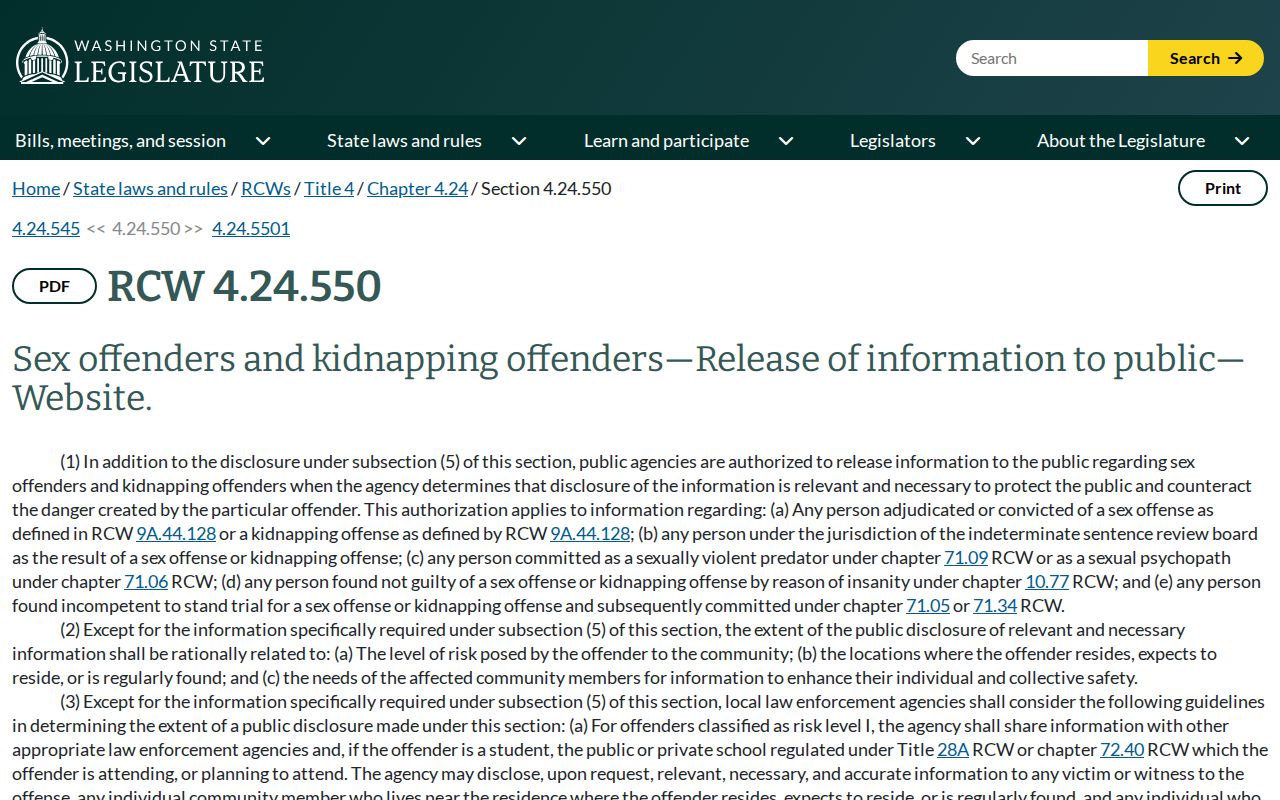
Public notice is therefore broader for higher assessed risk, while lower-level information remains more restricted.
Klickitat County Registry Versus Court File
A registry profile answers a current public-notification question. A Klickitat County court file shows filed charges, docket events, pleas, judgments, and sentences. The profile may give an offense label and conviction jurisdiction, but it is not a copy of the judgment. For those records, use the relevant clerk and the Klickitat County criminal court case process.
Washington Courts Case Search is an index that points toward a court record. The Klickitat County Clerk holds Superior Court files, while East and West District Courts hold their own misdemeanor records. A registry result may concern a conviction from another county or state, so the conviction-jurisdiction field matters. Request the filed judgment from that jurisdiction rather than assuming the Klickitat County sheriff holds the full prosecution file.
Washington's Criminal Records Privacy Act also separates conviction data, nonconviction data, and rules for dissemination. That broader record law helps explain why a registry, court index, and repository response may not display the same facts.
The Criminal Records Privacy Act source adds context for the limits around public Klickitat County record data.
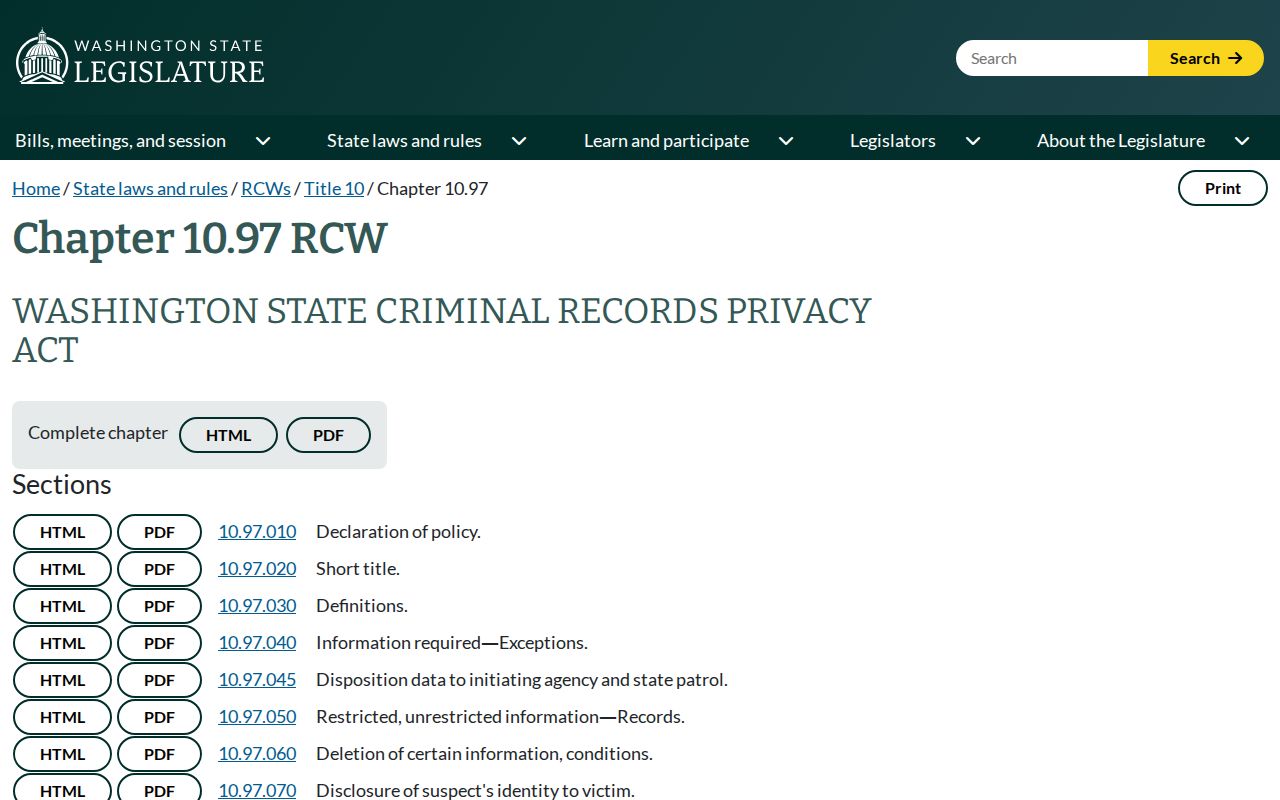
Each source must be read for its own legal purpose rather than treated as a duplicate database.
Lawful Use and Community Notification
Klickitat County sex offender information supports personal safety, family planning, and community awareness. It may help a resident understand an official notice, set a neutral location alert, or report a suspected registration issue. Use the sheriff and registry correction channels when information appears wrong. Never approach a listed person or household.
Practical safety steps do not require publishing names or images. Save the official link, discuss age-appropriate boundaries with family members, and use neutral plans for routes or meeting places when a notice is relevant. If a profile indicates a compliance concern, give that fact to the sheriff. Do not organize surveillance, share an unverified address, or encourage others to confront anyone.
Misuse can be a crime: Registry information may not be used to threaten, intimidate, harass, or commit a crime against a registrant or household. Washington's public-notification framework in RCW 4.24.550 authorizes lawful disclosure, not vigilantism or unlawful discrimination.
Public listings can change. Verify a profile through the linked official registry or Klickitat County Sheriff's Office before acting on a safety concern. If danger is immediate, call 911. For a nonurgent concern, use the sheriff's non-emergency line and provide the source, location, and reason for the report.
The registry is one layer of public information. It does not prove that a person who is absent has no sex-offense history, and it does not show every nonpublic law-enforcement fact about a listed person. Lawful use begins with those limits. It ends with official reporting and verification, not personal enforcement.
Suspected noncompliance is an agency matter. A resident can provide a clear tip, preserve the official source, and let trained staff assess it. That response protects the community while reducing the risk of a false match or unlawful confrontation.